Okay so before I get into the ideas, here's the thing everyone actually wants to know upfront.
A cove light is just an LED strip tucked into a small ledge in your ceiling. You see the glow, you don't see the bulb. That's it. For a Bangalore 2BHK, living plus dining together will usually cost you somewhere in ₹35k to ₹75k. Use 2700K to 3000K warm white. Get a dimmer, seriously. You need roughly 9.5 feet of ceiling height for the whole thing to look right, otherwise the room feels shorter. It's not your main light. It's just the layer that makes the room feel bigger and softer than it is.
That's the summary. Rest of this is if you actually want to think about which style suits your home.
## First, what even is a cove light
Indirect lighting. That's the whole idea. Nothing fancier than that.
Instead of a bulb sitting on top of your head, you build a small step or groove into the false ceiling and hide an LED strip inside it. The light bounces off the ceiling and comes back down as a soft wash. You get the glow. The source stays invisible.
That's why cove ceilings look premium. No glare. No harsh shadow under your eyes when you're sitting on the sofa. Same trick five-star hotels have been doing forever, honestly.
Bangalore apartments? Usually 9.5 to 10 feet ceilings. Villas closer to 10 or 11. Either way, if you're doing a false ceiling anyway, adding a cove is probably the single biggest visual upgrade you'll get for the money you spend.
## 10 cove ceiling ideas we've actually done in Bangalore homes
Not Pinterest boards. Real projects, with what we picked and why. Some of these are boring, some are showoff, most are boring. Most homes only need boring done well.
### 1. The perimeter cove. Start here if you're new to this.
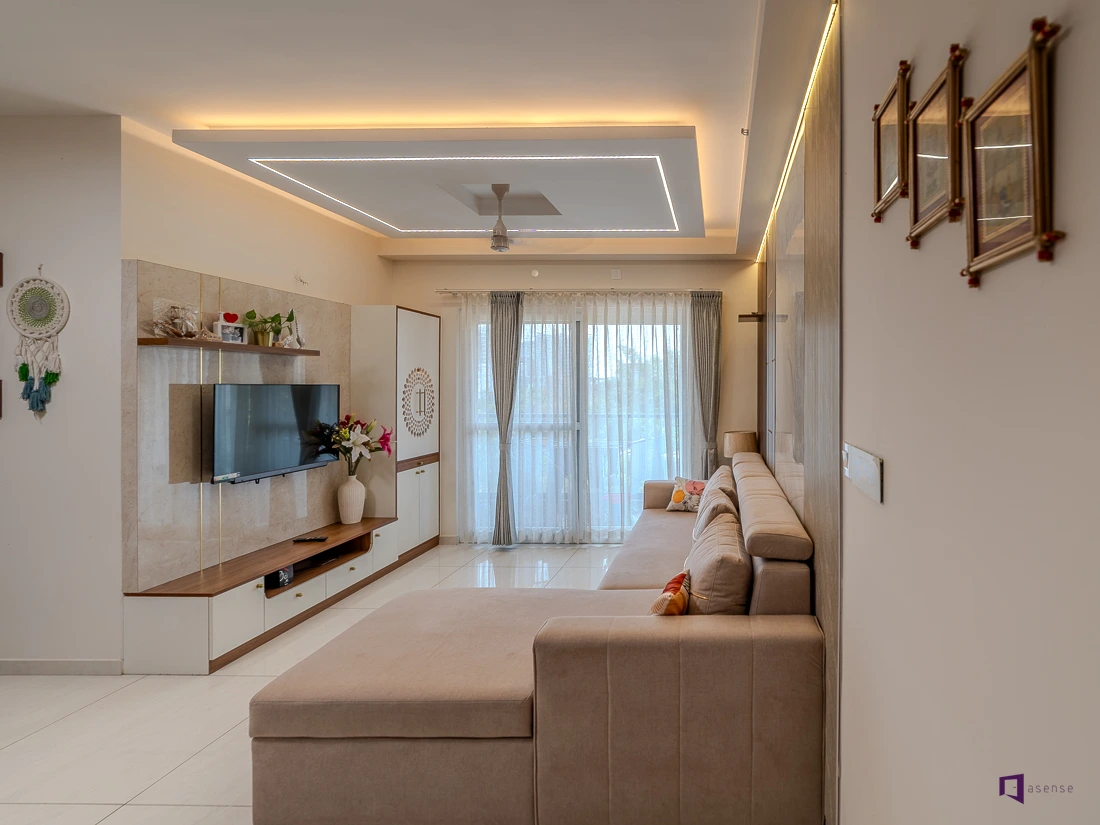
Just a slim step around all four walls of the room. LED strip inside, warm white 3000K, dimmer on the wall. That's the whole design.
We build this more than any other version, mostly in 2BHKs in Whitefield, Sarjapur, Electronic City. The kind of homes where the ceiling is just a plain builder-slab and the owner wants a quick premium feel without going overboard. Drops your ceiling by maybe 4 inches, so you barely notice the loss of height. A 12 by 15 living room lands somewhere around ₹35k to ₹45k including the LEDs.
Honestly? If it's your first false ceiling and you're not sure, just do this. You won't regret it.
### 2. Two layers so you can change the mood
One warm strip at 3000K for evenings. One cooler 4000K for work-from-home hours. Two switches, done.
Did this in a Koramangala home office last year. Owner switches to the cool white when he's on calls, warm one takes over after 7pm. It's like having two different rooms depending on the time. Adds maybe ₹6k to ₹9k over a standard cove. Worth it if you're spending 8 hours a day in the room anyway.
### 3. A curved cove above the bed, if there's a kid
Straight lines are fine. Everyone does them. But if you curve the cove, especially in a kid's room, it becomes something the child remembers.
We did a wave-shaped cove above a five-year-old's bed once. Warm 3000K, on a dimmer. His mom told us months later he still points at it before falling asleep and calls it "my moon". Curves cost about 15-20% more, because the gypsum guy has to shape it properly and flexible LED strips are pricier. But for a child's room? Come on.
### 4. Wood + hidden cove = resort vibe
Teak or veneer planks running across the ceiling with a warm LED strip washing behind them. This is the detail that turns a dining room into something that feels like a small resort in Coorg. Sounds dramatic. It kind of is.
We did this in a Sarjapur villa where the family wanted "earthy but modern". One thing to watch out for though. Wood absorbs light. So if you're doing this, don't be stingy with the LED, use around 12W per running foot at least. Otherwise the ceiling looks dim and the whole effort was wasted.
### 5. A floating "island" in the middle of the room
A smaller rectangle of false ceiling that doesn't touch any wall. Just floats in the middle of the room with cove lights on its underside. From below it looks like the ceiling is hovering there.
We do this a lot in open-plan flats near Manyata and Bagmane, where the builder gave you one big L-shaped hall and you can't figure out where the living room ends and the dining starts. The floating island does the separation for you. No wall needed, no partition. Just light.
### 6. Just one cozy corner. That's it.
You don't have to redo the whole ceiling. Sometimes the smart move is to just light up one corner.
Yelahanka home last year. Client wanted her reading nook to feel special. We built a small dropped section only above her armchair, cove lit at 2700K, dimmer. About ₹8k total. She texted us a week later and said it's now the only chair anyone in the family wants to sit on, and she's had a fight about it with her husband. So there's your marketing testimonial I guess.
### 7. Colour changing, but don't be silly about it
RGB or RGBW is fun. It's also easy to overdo. What you actually want is a strip that does warm white 90% of the time and only pulls out colours for movie nights, birthdays, Diwali.
Important thing here: buy RGBW, not just RGB. The W stands for a proper warm white channel. Skip that and your everyday "white" will look faintly greenish. It's the kind of thing you don't notice at first and then you can never un-see it.
HSR Layout media room. We did amber for cricket matches, deep blue for late night movies, warm white otherwise. Kids in that house think their living room is a mini cinema now. Extra cost was about ₹8k to ₹15k, plus a decent controller.
### 8. One straight line. Nothing else.
For people who want the effect but hate visual clutter. One clean strip. Along the TV wall, or along the length of the bedroom. Nothing else.
Marathahalli couple asked for exactly this. "Nothing flashy, just clean." So we ran one 12ft strip in a 3 inch shadow gap along the bedroom's long wall. Genuinely one of the nicest things we've built. Minimal doesn't mean cheap-looking when the proportions are right.
### 9. Yes you can do cove lights with a ceiling fan
Most asked question on site, no question. "Sir, we have a fan, can we still do this?" Yes. You just design a circular or square cove around the fan mount, leaving 12 to 15 inches clearance so the blades don't hit anything.
BTM Layout flat. The fan sits inside a lit ring now. Instead of the fan looking like an ugly thing you're forced to have, it becomes the centre of the design. Especially works if you have a wooden-blade fan, those suddenly look intentional.
### 10. One continuous cove flowing through the whole house
In a JP Nagar bungalow, we ran the same profile from the living room, through the passage, into the dining. Same width, same colour temperature, same finish, everywhere. From the entrance the ground floor reads as one glowing volume. The owner said his guests kept asking if he'd stayed at a boutique hotel and copied the design.
Only works if your plan is genuinely open and ceiling heights match across rooms. Otherwise the transition looks awkward. So check first before you fall in love with the idea.
## What all of this actually costs in Bangalore right now
These are the numbers we quote from our own factory. Prices move around a bit depending on materials and how complex the ceiling shape is, but this'll give you a solid ballpark.
| Item | 2026 range |
|--------------------------------------|----------------------|
| Gypsum false ceiling with cove ledge | ₹85 to ₹130 per sq ft |
| POP false ceiling with cove ledge | ₹75 to ₹110 per sq ft |
| Good quality warm-white LED strip, 24V | ₹150 to ₹250 per rft |
| RGBW or CCT-tunable strip | ₹280 to ₹400 per rft |
| Driver, dimmer, wiring per zone | ₹2,500 to ₹6,000 |
| Full 2BHK living-dining cove | ₹35k to ₹75k |
| Full 3BHK all-room package | ₹90k to ₹1.8L |
Ask for an itemised written quote. If someone gives you a single "₹X per room" figure, something's hidden in there. Every time.
## Cove vs downlights vs profile lights. Which one where?
Fastest way to explain this is a table, honestly.
| | Cove lights | Downlights | Profile lights |
|--------------|------------|-------------|-------------|
| Look | Soft wash, source hidden | Round spots pointing down | Sharp line on ceiling |
| Where it shines | Living, dining, bedroom | Kitchen, bathroom, wardrobe | TV wall, hero rooms |
| Glare | None | Some, unless deep-set | Some |
| Cost | ₹150 to ₹400 per rft | ₹450 to ₹1,200 per piece | ₹300 to ₹600 per rft |
| Ceiling needed | 9.5 ft plus | 9 ft plus | 9 ft plus |
Most well-designed homes use all three. Cove for ambient, downlights for task, profile as accents. You're not picking one or the other, they're not competing.
## Stuff people mess up. Please don't.
Cool white in the living room. 4000K or 5000K in a home makes it look like a Reliance Fresh. Stay in 2700K to 3000K everywhere except your work desk.
Skipping the dimmer to save ₹1500. This one hurts me. A cove without a dimmer is basically a light switch with extra steps. Just spend the ₹800 to ₹2500 on a decent dimmer. You'll use it every single day.
Cheap LED strips. Anything under ₹100 per rft will flicker in 8 to 14 months, and worse, the colour will shift. So your ceiling glows warm on one side and slightly greenish on the other. It looks awful. Not worth the ₹4000 you saved.
Trying to hide a cove where there's no space to hide one. If your builder gave you a 3-inch beam and you cram a cove inside a 2-inch step, everyone will see the LED dots. The ledge needs at least 3.5 inches deep and 4 inches tall to properly hide the strip.
Doing cove in every room. Not everything needs to glow. Pick two or three rooms that deserve it and leave the rest alone. Otherwise the eye stops noticing and the whole point is lost.
## The checklist you can show your electrician
Colour temperature: 2700K bedrooms, 3000K living/dining, 4000K only for study or kitchen.
Wattage: 9.6W per rft for main rooms. 4.8W is fine for a bedroom accent.
Strip: COB if you can afford it (looks like a continuous line, no dots). Otherwise SMD 2835 works.
Voltage: 24V, not 12V. Less brightness drop over long runs.
IP rating: IP20 indoors is fine. IP65 only for balconies or open-to-sky areas.
Dimmer: always.
Wiring: keep LED wiring on a separate circuit. Driver needs to be accessible. Do not bury it inside the ceiling and forget about it, because it will fail one day and then you're breaking gypsum to get to it.
Paint: matte white ceiling. Glossy shows every uneven joint under a cove and it looks bad.
## Why people book us for ceiling work
Cove lighting isn't a "stick the strip and switch it on" job. The finish depends on how you shape the ledge, which strip you pick, where the driver sits, and whether the gypsum was jointed and sanded properly. Any of those go wrong, the ceiling shows scallops or bright spots, and you'll be looking at that for years.
At Asense we do a full 3D render of your ceiling before any gypsum gets cut. You see exactly where the cove sits and how the light will fall. Our factory in Bengaluru handles the joinery, our site team wires every cove with a dimmer by default, and everything is under a 10-year workmanship warranty. Over 1,900 homes done so far across Whitefield, HSR, Sarjapur, Koramangala, Electronic City, Yelahanka, JP Nagar, Marathahalli, BTM. That kind of volume matters because it tells you fast whether your specific apartment can carry a cove or whether you're better off with a lighter detail.
Come see the finish in person before deciding. HSR Layout or Whitefield centre, whichever is closer. Coffee is on us.
## Questions we get all the time
**So what is a false ceiling cove light exactly?**
LED strip hidden in a step or groove of your gypsum or POP ceiling. Bulb stays out of sight, only the light shows. Gives you a soft glow with no glare.
**Okay but how much for my flat in Bangalore?**
Gypsum ceiling with the cove built in is ₹85 to ₹130 per sq ft. Add ₹150 to ₹350 per rft for the strip, driver and dimmer. For a standard 2BHK living-dining, you're looking at ₹35k to ₹75k. Depends on the design complexity, LED quality, and whether you want smart controls. All indicative.
**What colour temperature should I pick?**
2700K to 3000K warm white for living, bedroom, dining. 4000K neutral only for study or kitchen. Above 5000K in a home looks clinical. If you can't decide, get a CCT-tunable strip and switch between warm at night and cooler in the day.
**Can I use only cove lights in a room, nothing else?**
No. Cove is ambient. It's mood, not function. You still need task lighting to read or cook, and accent for artwork. Cove is one layer, not the whole plan.
**How tall does my ceiling need to be?**
9.5 feet finished is the safe minimum in a Bangalore flat. Below that, do only a peripheral cove, don't drop the entire ceiling. Otherwise the room feels boxy.
**Will it jack up my electricity bill?**
Not really. Modern LED cove strips draw 4.8 to 9.6 watts per rft. A 30rft living room cove uses 150 to 280 watts, about the same as two ceiling fans. Running it 4 to 5 hours daily adds maybe ₹80 to ₹150 a month in Bangalore rates. LEDs last 30k to 50k hours too, so replacements aren't really a thing you'll deal with for years.
## Want to see how it'd look in your place?
If you're planning interiors or a renovation in Bangalore, we can build you a 3D render of your actual ceiling, with the cove sized to your room, before we touch anything.

Choose interiors designed with superior quality material, leaving no room for defects.

Get beautiful interiors for your new home in just 45 days. That’s our delivery guarantee.

Explore design ideas and co-create your dream home with our experienced designers

Complete your design journey and get unwavering support from our dedicated care team.